UCEED 18 MSQ (SECTION B ) SOLUTIONS
UCEED 18 paper is divided into three sections, A, B and C.
Section A (80 Marks) contains a total of 20 Numerical Answer Type (NAT) questions.
Section B (100 Marks) contains a total of 25 Multiple Select Questions (MSQ).
Section C (120 Marks) contains a total of 40 Multiple Choice Questions (MCQ).
IN THIS POST UCEED 18 MSQ (SECTION B ) SOLUTIONS ARE GIVEN
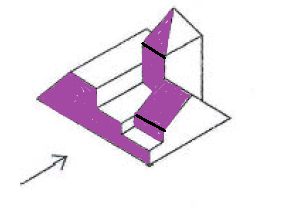
Q.21 On the left is a photograph. Which option(s) is/are part(s) of that photograph?

Q.22 If spaces and special characters are ignored in the following text, which country/countries
is/are hidden in the text shown below?
I think the earth’s ecosystem will collapse very soon. Natural resources have been exploited for far
too long at the cost of the wellbeing of humankind, I am afraid. I don’t want to stir another controversy
but I ardently feel that the time has come for us to take urgent actions to save our planet from
manmade disasters.
A. Ghana
B. India
C. Peru
D. Iran
ANS As highlighted India and Iran (i.e, B and D ) are hidden in the text.
Tip : see the first letter of the option in the text for example G of Ghana ,it comes in long,well being, urgent then see the following next letters if that matches with the word Ghana.here the ans is no. Like wise check other options.
Q.23 The CBI is investigating a dangerous gang of three criminals. The criminals are Donga, Tirudan
and Daaku. The investigation team consists of Pradyuman, Daya, Fredricks, Salunkhe, Tarika and Purvi.
Each criminal is to be investigated by exactly two investigators, and each investigator investigates
exactly one criminal. The investigation is to be conducted subject to the following constraints:
Pradyuman and Daya do not investigate the same criminal.
Fredricks and Salunkhe investigate the same criminal.
If Fredricks investigates Tirudan, then Tarika must investigate Daaku.
Given these constrains, which of the following could be the acceptable assignment(s) of investigators
to potential criminals?
A. Fredricks & Salunkhe investigate Tirudan, Pradyuman & Daya investigate Donga and Tarika &
Purvi investigate Daaku
B. Fredricks & Salunkhe investigate Donga, Tarika & Pradyuman investigate Tirudan and Daya &
Purvi investigate Daaku
C. Tarika & Purvi investigate Donga, Fredricks & Pradyuman investigate Tirudan and Salunkhe &
Daya investigate Daaku
D. Daya & Purvi investigate Tirudan, Tarika & Pradyuman investigate Daaku and Fredricks &
Salunkhe investigate Donga.
ANS # As per the first constraint
Pradyuman and Daya do not investigate the same criminal. Option A is incorrect.
# Option B satisfies all constraints ,so it is correct.
#As per the constraint If Fredricks investigates Tirudan, then Tarika must investigate Daaku.
Option C is incorrect. / wrong
# Option D satisfies all constraints , so it is correct.
Q.24 If, 9 + 8 means 9 is the child of 8, and 7 * 6 means that 6 is the wife of 7, then which of the
following statements can be derived from 2 + 3 * 1 + 4 * 5?
A. 2 is the grandchild of 4
B. 1 is the daughter of 5
C. 5 is the grandfather of 3
D. 1 is the mother of 2
2 is the child of 3 from (2+3)
1 is the wife of 3 from (3*1)
1 is the child of 4 from (1+4)
5 is the wife of 4 from ( 4*5)
Make hierarchy chart from the above information .
5 and 4 are grand parents
1 and 3 are parents
2 is child.
so options A,B,D are correct.
Tip : keep in mind the gender also in solving such problems.
to practice logical reasoning you can visit
Q.25 30 circles are given below, with a set of rules:
1. The bigger the circle, the farther away it is from us.
2. The thinner the line of the circle, the closer it is to us.
3. The red circles are farther away from us as compared to the blue circles.
Which of the options given below is/are TRUE?

A) Circle 25 is the closest to us
B) Circle 25 is farthest from us
C) Circle 24 is closer to us than circle 14
D) Circle 6 is closer to us than circle 8
ANS From above set of rules we conclude that smaller, thinner and blue circles are closer to us.
# circle 25 is smallest ,thinnest and blue ,so Option A is correct.
# circle 25 is closest therefore can not be farthest, Option B is incorrect.
# circle 24 and 14 are red and 24 is smaller ,so Option C is correct.
# circle 6 is thicker and bigger in size than 8 so it is farther ,Option D is incorrect.
Option A and C are correct ans.
Q.26 Which concept does this image by Escher illustrate?

A. Tessellation
B. Figure and Ground
C. Mise en Scene
D. Collage
# A tessellation of a flat surface is the tiling of a plane using one or more geometric shapes, called tiles, with no overlaps and no gaps.
# Figure–ground organization is a type of perceptual grouping which is a vital necessity for recognizing objects through vision. In Gestalt psychology it is known as identifying a figure from the background.
# The arrangement of everything that appears in the framing – actors, lighting, décor, props, costume – is called mise-en-scène, a French term that means “placing on stage.” The frame and camerawork are also considered part of the mise-en-scène of a movie.
# Collage is a piece of art made by sticking various different materials such as photographs and pieces of paper or fabric on to a backing.# Figure–ground organization is a type of perceptual grouping which is a vital necessity for recognizing objects through vision. In Gestalt psychology it is known as identifying a figure from the background.
# The arrangement of everything that appears in the framing – actors, lighting, décor, props, costume – is called mise-en-scène, a French term that means “placing on stage.” The frame and camerawork are also considered part of the mise-en-scène of a movie.
ANS : from the above definitions option A and B are correct.
Q.27 Read the passage given below, written by Nick Hughes:
“We tend to treat power as though it is intrinsically valuable. We seek it out and covet it, quite
irrespective of how we might wield it and what it might get us. One need only look at the history of
totalitarian politics to recognise this tendency in its most grotesque form. But power isn’t intrinsically
valuable, it’s only instrumentally valuable – valuable as a means to an end. And whether or not they
are objectively valuable, the ends that matter to us, the things that we care about most – our
relationships, our projects and goals, our shared experiences, social justice, the pursuit of knowledge,
the creation and appreciation of art, music and literature, and the future and fate of ours and other
species – do not depend to any considerable extent on our having control over a vast but largely
irrelevant Universe. We might be distinctly lacking in power from the cosmic perspective, and so, in a
sense, insignificant. But having such power and such significance wouldn’t make much of a difference
anyway. To lament its lack and respond with despair and nihilism is merely a form of narcissism. Most
of what matters to us is right here on Earth.”
Which of the statements is/are TRUE of the paragraph above:
A. The author argues that intrinsic value is distinct from instrumental value and that power
possesses the latter of the two.
B. “Humans and our significance in the universe”, is one of the themes discussed in the
passage.
C. The philosophies of nihilism and narcissism are suggested as remedies by the author.
D. The author suggests that we look at the history of totalitarian politics to recognise that we
shun power in the most grotesque form.
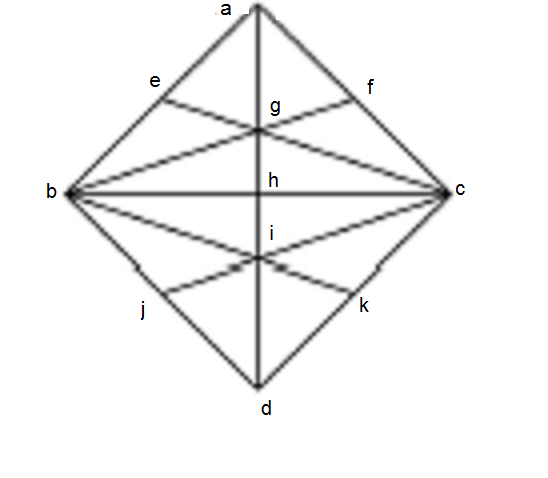
Q.28 Which option(s) is/are simple rotations of the figure given below?

Q.29 Read the statements below:
All female and male natives in their country are strong.
Some men in their country are migrants.
All migrants in their country are not strong.
Not all migrants are women.
Based on the above, which conclusion(s) stated in the options is/are valid?
A. Some women in their country are strong.
B. Some migrants in their country are men.
C. Some people in their country are not strong.
D. All strong people in their country are women
ANS : A is correct ( native female are strong but migrants female are not strong).
B is correct (because not all migrants are women).
C is correct ( because migrants are not strong)
D is wrong ( because all female and male natives in their country are strong.
Q.30 Which of the following words are similar in meaning?
A. Scribble
B. Doodle
C. Nibble
D. Feeble
meanings of of above words are
# Scribble means write or draw (something) carelessly or hurriedly.
# Doodle means scribble absent-mindedly.
# Nibble means take small bites out of. or show cautious interest in a commercial opportunity
# Feeble means lacking physical strength, especially as a result of age or illness.
Ans : A and B are correct options.
Q.31 Which of the following words is/are similar in meaning to ‘Centre’?
A. Heart
B. Core
C. Nucleus
D. Nub
ANS A,B,C,D
Q.32 Consider this poem:
Now, marriages happen in halls
They used to happen at home
Honeymoon too
Before they wandered into halls
Stage. Actors. Audiences from afar.
Receptions never really took place
Yet they would go on for days.
Now, receptions include
Those who don’t really figure.
Show face, shove envelope (gifts not accepted)
Grin for the camera.
Get out. Not all that bad.
Quick and efficient. No one really cares.
Which mood(s) does the poem evoke?
A. Cynicism
B. Nostalgia
C. Happiness
D. Lust
ANS : A,B
# Cynicism - Cynicism is an attitude or state of mind characterized by a general distrust of others' motives.
# Nostalgia -Nostalgia is a sentimentality for the past, typically for a period or place with happy personal associations.
# Happiness - positive or pleasant emotions ranging from contentment to intense joy.
# Lust - Lust is a craving, it can take any form such as the , lust for money or the lust for power.
Q.33 Goethe said, “Doubt grows with knowledge”. From this perspective, who would a
knowledgeable person be?
A. One for whom doubt does not grow with knowledge
B. One who has no doubt
C. One who has doubt
D. One whose doubt grows with knowledge
ANS : C,D
Q.34 Theory is already existing knowledge and Practice is knowledge that comes by ‘doing’.
Based on this statement which of the following is/are TRUE?
A. Theory precedes Practice.
B. Practice is knowledge in action.
C. Knowledge without ‘doing’ is Theory.
D. Theory and Practice are one and the same.
ANS : A,B,C
Q.35 Which of the following quotes celebrate(s) technology?
A. “Did that search engine really know what you want, or are you playing along, lowering your
standards to make it seem clever?”
B. “ I fear that we are beginning to design ourselves to suit digital models of us, and I worry
about a leaching (leakage) of empathy and humanity in the process”
C. “The approach to digital culture I abhor would indeed turn all the world’s book into one
book”.
D. “What a computer is to me is the most remarkable tool that we can ever come up with. It’s
the equivalent of a bicycle for our minds”.
ANS : D
Q.36 Consider the drip irrigation system in villages on hilly terrain. Which of the following
statements is/are correct?
A. Bamboo pipes can be used to divert perennial springs on the hilltops to the lower reaches by
gravity.
B. If the bamboo pipes have to cross a road they can be taken above the land.
C. This irrigation system is useful for the places with high ground water level.
D. The bamboo pipes could be replaced with PVC pipes.
ANS :A,B,D
Q.37 Six pacmen have joined hands to take revenge from an evil ghost. They are standing around
in a circlular formation. Lo and behold, a white star full of pure light emerges in the centre. In
complete disbelief, the pacmen are mesmerized. Which of the gestalt laws of perception explain(s)
the appearance of the star in the centre?
ANS :A,B,D
Q.38 If the black lines represent cutting lines and dotted pink lines are folding lines, which of the
options correctly represent(s) the opened up surfaces of the solid shown?

Q.39 Which of the following images belong(s) to Ajanta?

B. L
C. K and M
D. J and I
ANS : A,C,D ( except L )
Q.40 Based on the paintings below, which of the following statements is/are TRUE?
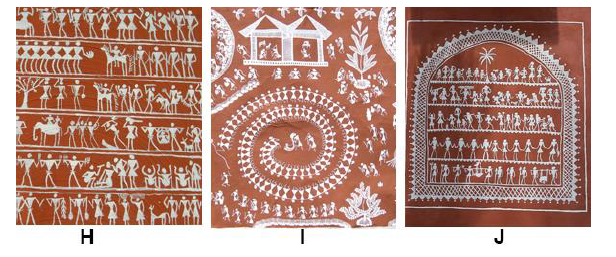
A. These paintings use geometric grids for their construction.
B. All three painting are from Maharashtra.
C. All these paintings draw upon tribal folklore.
D. These paintings are wall murals.
ANS : C,D
Q.41 Which of the following is/are greenhouse gas(es)?
A. Hydrogen Sulphide
B. Carbon Dioxide
C. Chlorine
D. Methane
ANS :B,D
Q.42 Which of the options represent(s) correctly the opened up surfaces of the solid shown?

ANS : A,D
Q.43 Consider the following text by Edward Shanken:
“By 2000, it had become increasingly apparent that the exclusion and ghettoization confronting the
practice and criticism of new media art and the larger historiography of art and technology required
an explicit suturing strategy. In ‘Art in the Information Age’ (2001) I argued that by ‘interpreting
conceptual art and art-and-technology as reflections and constituents of broad cultural
transformations during the information age’ categorical distinctions can be relaxed, allowing parallels
to be drawn between seemingly diverse theory of systems aesthetics and the notion of software as a
metaphor for art. My analysis of works by Levine, Haacke and Kosuth in ‘Software’ led to the
conclusion that in the information age, ‘meaning and value are not embedded in objects, institutions
or individuals so much as they are abstracted in the production, manipulation and distribution of signs
and information’. Finally, I implicitly applied Burnham’s systems approach to analyse the system by
which art history is written. Using Haacke and Ascott as examples, I claimed that the historicization of
an artist’s work as conceptual art or art and technology ‘says less about their work than it does about
the institutional mechanisms that have created and reinforced categorical distinctions...at the
expense of identifying continuities between them.”
Which of the statements is/are TRUE of the paragraph above?
A. Historicization of an artist’s work speaks only of institutional mechanisms that create and
define categories.
B. Categorical distinctions do not allow parallels to be drawn between seemingly diverse
practices.
C. If software is a metaphor for art, meaning and value are more in the making and distribution
of signs and information.
D. Conceptual art cannot be interpreted as reflections of broad cultural transformations.
ANS : B,C
Q.44 The following diagram shows the distribution of population in an apartment building as per
the profession of its residents.

Which of the following is/are correct?
A. Doctors and businessmen combined is less than half of the total residents.
B. About 1/3 of the population is engineers.
C. Engineers and designers combined is about 60% of the residents.
D. Doctors and businessmen combined is more than half of the total residents
ANS : A,B,C
Q.45 In which of the following applications is a convex lens used?
A. Peepholes
B. Magnifying glass
C. Microscope
D. Car headlight
ANS : A,B,C,D